There are different types of EQ, here we will see the main ones:
Graphic EQ.
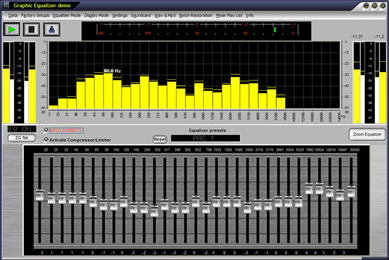
These are made up of many slider sliders that each increase or decrease a fixed frequency (some units have 32 sliders, some have more, some have less). Graphic EQs are not so much used on channels (like the other EQs) as they are on the main outputs of a mixing console in a real situation to solve any specific problems that arise. They can also be used to help compensate for known synchronization problems. They do not have a lot of flexibility because they lack several options that other more advanced types of EQ have. Below is a graphical EQ:
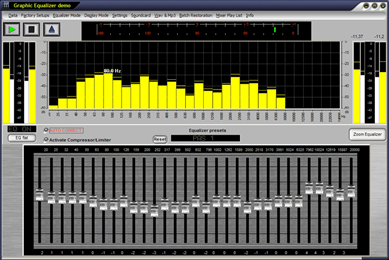
A graphic equalizer features a set of fixed frequency bands, each with a slider that allows you to increase or decrease the gain in that specific band. This type of equalizer is known for its ease of use and clear visual representation, allowing for quick and effective adjustments. Graphic equalizers are ideal for live applications and for users who prefer a visually intuitive setup. Each slider corresponds to a fixed frequency, and moving them up or down increases or decreases the frequencies at those points. Although they offer less precision than parametric equalizers, graphic equalizers are very effective for quick adjustments and general corrections.
Parametric Equalizer
The parametric equalizer offers much more detailed and flexible control over the sound. Unlike the graphic equalizer, the frequency bands in a parametric equalizer are not fixed. Instead, they can be adjusted in three main parameters: center frequency, gain (boost or cut) and bandwidth (Q). This ability to fine-tune each frequency band allows fine manipulation of the audio spectrum, making it ideal for professional recording studio applications. Parametric equalizers allow users to identify and correct specific problems in the sound, such as unwanted resonances or frequencies in need of enhancement, with a level of detail unmatched by other types of equalization.
The parametric equalizer is the most accurate and versatile type of equalizer, as it allows you to select the center frequency to be equalized, the bandwidth (Q) and the gain. There are also multiband parametric equalizers, the most common is the 4-band parametric equalizer. It is also the most complex equalizer of all and can be difficult to set up when no graphical representation is available (analog hardware).
This equalizer can be used as a filter to remove or attenuate unwanted frequencies, noise or interference. These problems usually occur in a certain frequency range, so a parametric equalizer is ideal for this purpose.
Become an expert in equalization with the recommended book “ EQ in Music Production” (click on the image to go to the link):

Equalization is accomplished through different types of equalizers, each designed to perform specific functions and provide precise control over the frequency spectrum. The most common types of equalization used in music production are described below.
Shelving Equalizer
Shelving equalizers are designed to adjust all frequencies above (high shelf) or below (low shelf) a specific frequency. This type of equalization is extremely useful for making global adjustments at the extremes of the frequency spectrum. For example, a high shelf EQ can boost or cut all frequencies above a given point, which is useful for adding sparkle to a mix. On the other hand, a low shelf EQ can control the low frequencies, adding depth or reducing excess bass. Shelving EQs are essential for balancing the overall tonality of a mix and adjusting the tonal character of a track globally and effectively.