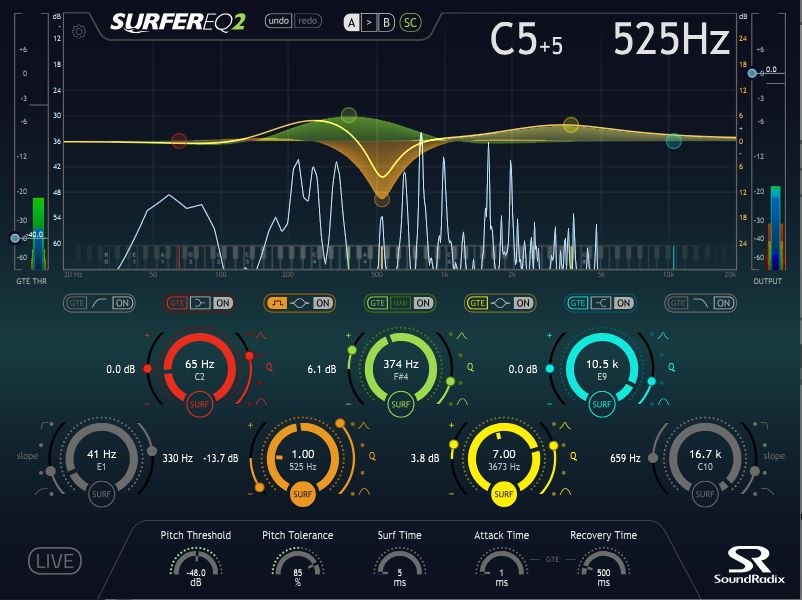
Equalization (EQ) is a fundamental tool in music production. It allows you to shape the sound by adjusting the amplitude of different frequencies. Understanding the different types of equalizers will help you make informed decisions and achieve the sound you’re looking for.
Main Types of Equalizers:
There are several types of equalizers, each with their own characteristics and applications. The most common are:
- Graphic Equalizers:
- How they work: They divide the frequency spectrum into fixed bands, each with a slider (fader) to adjust the gain (boost or cut) of that band.
- Characteristics: They are easy to use and provide a visual representation of the frequency spectrum. However, they offer less precise control than other types of EQ.
- Uses: They are useful for quick, general adjustments, especially in live situations or for listening room equalization.
- Example: A 31-band graphic equalizer divides the audible spectrum into 31 frequency bands, each with a slider control.
- Parametric Equalizers:
- How they work: they offer precise control over three key parameters:
- Frequency: selects the center frequency to be adjusted.
- Gain: Adjusts the amount of boost or cut in decibels (dB).
- Bandwidth or Q Factor (Q): Controls the width of the frequency band that is affected by the setting. A high Q means a narrow band, while a low Q means a wide band.
- Characteristics: They are very versatile and allow precise adjustments to be made at specific frequencies.
- Uses: They are ideal for sculpting the sound of individual instruments, correcting resonance problems or enhancing specific characteristics.
- How they work: they offer precise control over three key parameters:
- Semiparametric Equalizers:
- Operation: They are a simplified version of parametric equalizers. They offer control over gain and frequency, but the bandwidth (Q) is fixed or has a limited number of options.
- Characteristics: They offer a good balance between control and ease of use.
- Uses: They are useful for general tuning and for situations where control is not required as precisely as with a full parametric equalizer.
- Shelving EQs (Shelving EQ):
- How they work: they affect all frequencies above or below a cutoff frequency. A “low shelf” affects low frequencies, while a “high shelf” affects high frequencies.
- Characteristics: They are useful for smoothly boosting or attenuating entire frequency ranges.
- Uses: They are often used to give “warmth” (bass boost) or “brightness” (treble boost) to a sound.
Become an expert in equalization with the recommended book “ EQ in Music Production” (click on the image to go to the link):

- Filters:
- High-Pass Filter (High-Pass Filter or HPF): allows high frequencies to pass through and attenuates low frequencies below a cutoff frequency. It is used to remove low frequency noise, “rumble” or “mud” from a mix.
- Low-Pass Filter (LPF): Allows low frequencies to pass through and attenuates high frequencies above a cutoff frequency. It is used to soften bright sounds or to create “phone” effects.
- Band-Pass Filter: Allows a specific range of frequencies to pass through and attenuates frequencies above and below that range. It is used to isolate a specific frequency band.
- Band-Reject Filter (Notch Filter or Band-Reject Filter): Attenuates a specific range of frequencies and allows frequencies above and below that range to pass through. Used to eliminate unwanted resonances or specific noises.
- Dynamic Equalizers:
- How it works: unlike static equalizers, dynamic equalizers adjust the equalization based on the incoming audio signal. They behave similarly to a multiband compressor, but with the ability to increase or attenuate the gain.
- Characteristics: They are useful for controlling problematic frequencies that only appear in certain parts of a song or recording.
- Uses: They are often used to control sibilance in vocals or to tame resonant frequencies in instruments.
Additional Considerations:
- Phase: EQ can affect the phase of the audio signal. Aggressive settings can cause phase problems that affect the mix.
- Context: The best way to use equalization is to listen to the instrument in the context of the entire mix.
- Less is more: Often, small adjustments are more effective than large boosts or attenuations.
- Critical hearing: The most important tool for equalization is your hearing. Trust what you hear and experiment.
Understanding the different types of EQs and their characteristics will allow you to make more informed decisions and achieve more professional mixes. Remember that practice and experimentation are key to mastering the art of equalization.