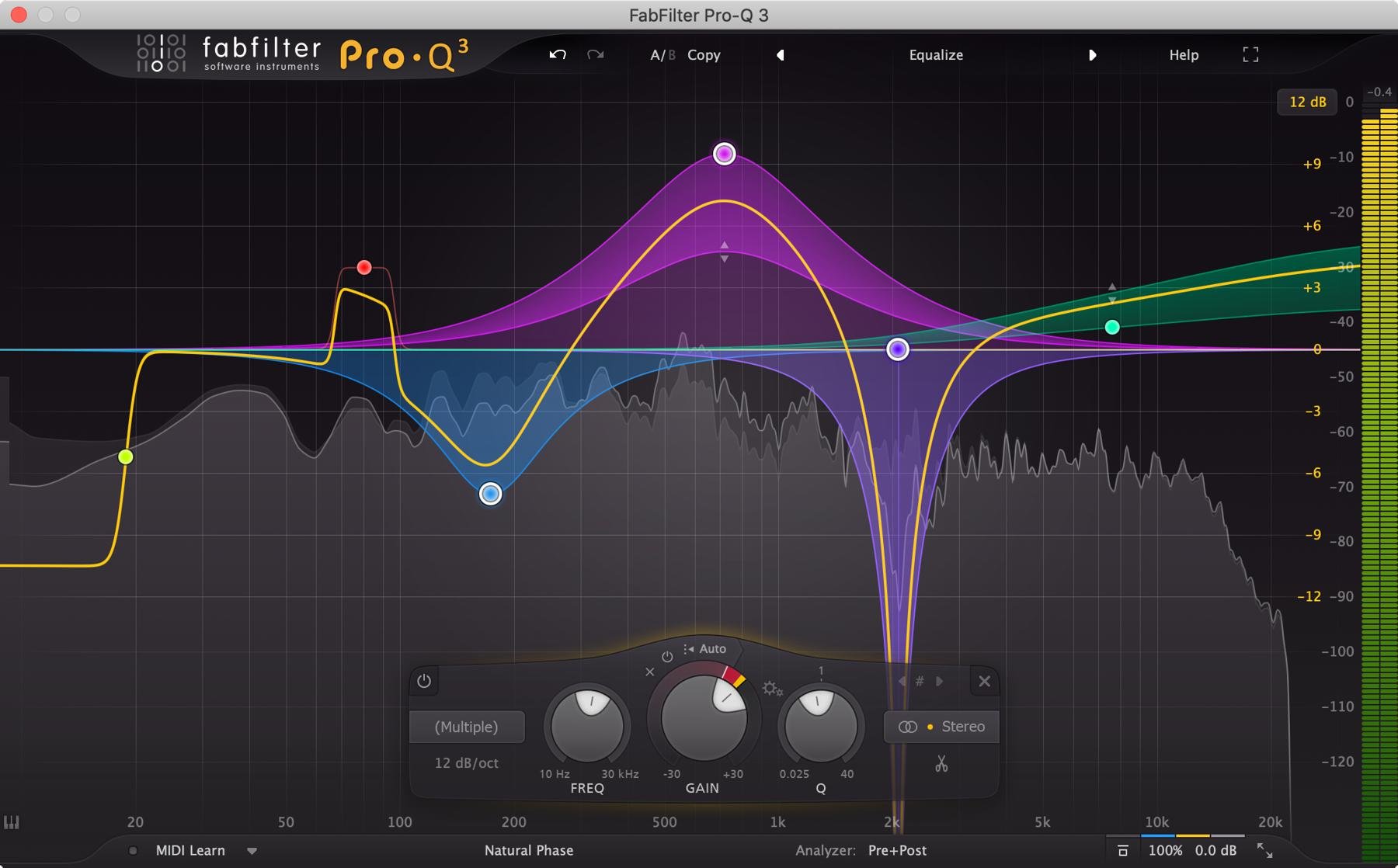
What is equalization in music production?
Equalization, often abbreviated as EQ, is a fundamental tool in music production that allows you to modify the balance of the frequencies that make up a sound. In simple terms, equalization allows you to adjust the volume of different frequency ranges, from deep bass to bright highs.
The frequency spectrum
To understand equalization, it is important to understand the audible frequency spectrum, which is measured in hertz (Hz). This spectrum ranges from approximately 20 Hz (the lowest bass we can hear) to 20 kHz (the highest treble). It is generally divided into the following bands:
- Bass (20 Hz – 250 Hz): contains the base and power of the sound.
- Mid-bass (250 Hz – 500 Hz): Provides warmth and body to the sound.
- Mid (500 Hz – 2 kHz): Holds most of the fundamental information of voices and many instruments.
- High Mid (2 kHz – 4 kHz): Provides presence and clarity.
- Treble (4 kHz – 20 kHz): Adds sparkle, air and detail.
How does equalization work?
An equalizer divides the frequency spectrum into bands that can be adjusted individually. There are several types of equalizers, but the most common are:
- Graphic equalizer: displays the frequency bands on a graph with vertical sliders that allow you to boost or attenuate each band.
- Parametric equalizer: Offers more control, allowing you to adjust the band center frequency, bandwidth (Q) and gain.
Types of equalization
Become an expert in equalization with the recommended book “ EQ in Music Production” (click on the image to go to the link):

There are two main types of equalization:
- Subtractive equalization: Consists of attenuating problematic or unwanted frequencies to clean up the sound and improve clarity.
- Additive equalization: Focuses on boosting certain frequencies to shape the sound and highlight specific characteristics.
- Uses of equalization in music productionEqualization is used for a wide variety of purposes in music production:Tips for equalizingEqualization is an essential skill for any music producer. With practice and patience, you can learn to use it effectively to enhance your productions and achieve the sound you’re looking for.
- Listen carefully: Use good headphones or studio monitors and pay attention to how the EQ settings affect the sound.
- Less is more: Avoid drastic adjustments, as they can sound artificial. Often, small changes can make a big difference.
- Context is key: Consider how an instrument sounds in relation to the other elements of the mix.
- Use references: Compare your mix with professional recordings to get an idea of how it should sound.
- Experiment: Don’t be afraid to try different settings and discover what works best for each situation.
- Correct problems: Eliminate annoying resonances, reduce background noise or attenuate clashing frequencies between different instruments.
- Mixing: Shaping the sound of each instrument to fit well into the overall mix, creating space and clarity.
- Mastering: Making subtle adjustments to the overall tonal balance of the mix to optimize its playback on different audio systems.
- Sound design: Using EQ creatively to transform and manipulate sounds, creating interesting effects.