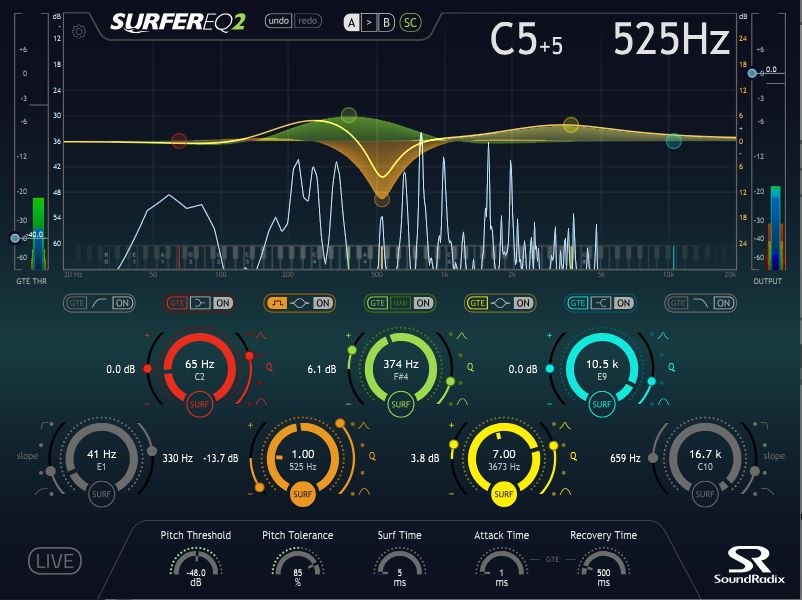
Equalization (EQ) is an essential tool in audio production that allows us to shape the timbre of a sound by adjusting the volume of its different frequencies. To master EQ, it is crucial to understand how these frequencies are distributed and how they affect the sound.
The audible spectrum and frequency bands
The human ear perceives sounds in a range of frequencies from 20 Hz (hertz) to 20 kHz (kilohertz). This range is known as the audible spectrum and is divided into different frequency bands that are associated with different characteristics of the sound:
- Sub-bass (20 Hz – 60 Hz): these are the lowest frequencies, which are felt rather than heard. They bring “weight” and “depth” to music, especially in genres such as hip hop, electronica and film music. Too much volume in this area can generate a “rumbling” or “muddy” sound.
- Bass (60 Hz – 250 Hz): This band contains the fundamental frequencies of instruments such as kick drum, bass and some wind instruments. They bring body and warmth to the sound. Too much bass can make a mix sound “heavy” or “fuzzy”.
- Mid-bass (250 Hz – 500 Hz): This zone is crucial for clarity and definition of vocals and other melodic instruments. Too much in this band can make a mix sound “boxy” or “nasal”.
- Mid (500 Hz – 2 kHz): This is the zone where most of the energy of vocals and many instruments is found. It affects the “presence” and “intelligibility” of the sound. Too much in this band can make a mix sound “harsh” or “aggressive”.
- High Mid (2 kHz – 4 kHz): This band affects the “clarity”, “attack” and “presence” of sounds. An excess in this zone can lead to hearing fatigue.
- Treble (4 kHz – 20 kHz): This band brings “brightness”, “air” and “detail” to the sound. It includes the sibilances of voices and the upper harmonics of many instruments. Too much treble can make a mix sound “shrill” or “harsh”.
How to apply equalization according to frequencies
Understanding these frequency bands helps us make informed decisions when equalizing:
- Clean up the “mud:” Often, frequencies between 200 Hz and 500 Hz can build up and make a mix sound “muddy.” Slightly reducing these frequencies can improve clarity.
- Add “warmth”: Slightly boosting frequencies between 100 Hz and 250 Hz can add warmth and body to a sound.
- Increase vocal “presence”: A small boost between 1 kHz and 4 kHz can improve the presence and intelligibility of a voice.
- Control sibilance: Attenuating frequencies between 6 kHz and 10 kHz can reduce annoying sibilance in vocals.
- Add “sparkle”: A slight boost above 10 kHz can add sparkle and air to a mix.
Become an expert in equalization with the recommended book “ EQ in Music Production” (click on the image to go to the link):

Important considerations
- Context is key: The way we EQ a sound depends on the context of the mix. A kick drum that sounds good on its own may not fit well with the rest of the instruments.
- Less is more: Often, small EQ adjustments are more effective than drastic changes.
- Listen carefully: Use good monitors or headphones and trust your ears.
- Use spectrum analyzers: These visual tools can help you identify problem frequencies.
Practical examples:
- Bass drum: For a punchy kick drum, you can boost the 60-100 Hz zone and attenuate slightly around 300-500 Hz to avoid “mud”.
- Voice: For a clear and present voice, you can slightly boost between 1 kHz and 4 kHz and attenuate sibilance between 6 kHz and 10 kHz.
- Acoustic guitar: For a full-bodied acoustic guitar, you can boost the 100-250 Hz zone and add brightness with a slight boost above 10 kHz.
Mastering the frequencies in EQ is an ongoing process that requires practice and experimentation. By understanding how different bands affect the sound, you can make more informed decisions and achieve more professional, balanced mixes.