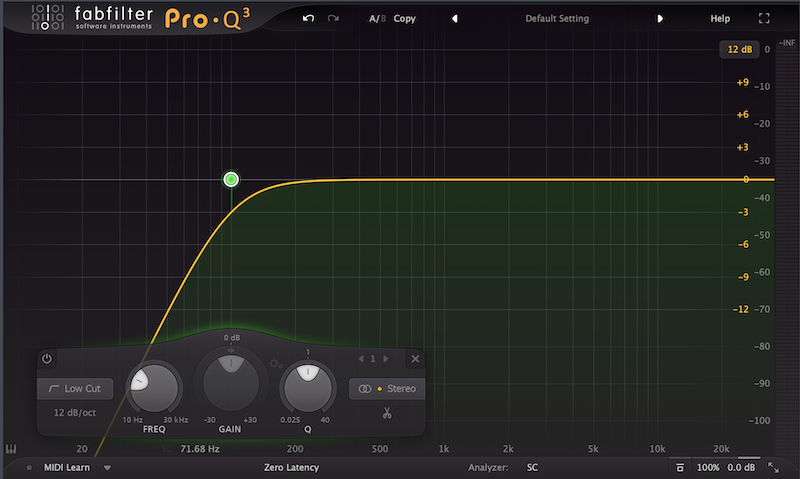
A shelving equalizer attenuates or boosts frequencies above or below a specific cutoff point.
Shelving equalizers come in two different varieties: high pass and low pass.
Low pass shelving filters pass all frequencies below a specified cutoff frequency, while attenuating all frequencies above the cutoff frequency. A High Pass filter does the opposite, passing all frequencies above the specified cutoff frequency while attenuating everything below it.
We see that the high pass filter passes all the high frequencies and removes the low frequencies. As we can see, the cutoff is not abrupt, but in general a curve is used so that the transition is not abrupt.
The high pass is generally used to cut deep bass frequencies that may disturb the mix. It is also used to correct vibrations or low frequency interference.
Low pass filter (low pass):
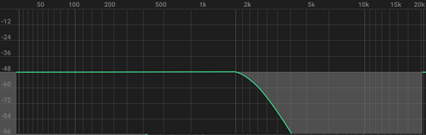
High pass filter (high pass):
We see that in the case of the low pass, we attenuate the high frequencies and let the rest through. The low pass is used to reduce, for example, hiss, sibilance, filtering of other instruments in the recording, or to remove high frequencies from instruments that do not need them, such as a bass guitar. We can also boost or boost frequencies using these filters.
Become an expert in equalization with the recommended book “ EQ in Music Production” (click on the image to go to the link):

