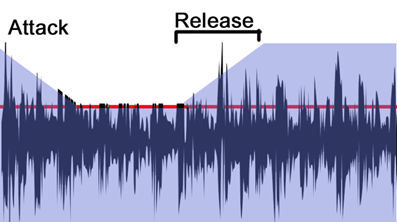
This parameter is related to time. It indicates how many milliseconds the Compressor will take to fully compress the audio signal when it exceeds the Threshold we have set.
If we set, for example, an attack time of 0 (zero) milliseconds, the compression will be performed instantaneously each time the signal exceeds the Threshold.
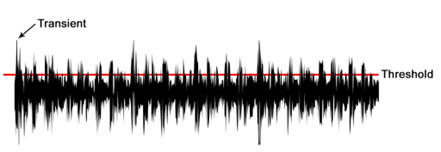
Below is an image of an UNCOMPRESSED sound wave. We can see the Threshold and the peaks that exceed it. The first milliseconds of a peak when it exceeds the Threshold are called Transients.
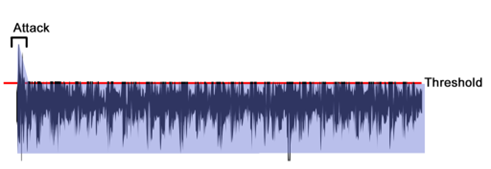
Next we will see the action of the compressor represented by the colored area. Here we see that the compressor takes a few milliseconds to act, from the moment it detects that the signal has exceeded the threshold. Let’s say that it takes three milliseconds to act until the signal is fully compressed. We see that the first three milliseconds of signal are preserved until they are compressed. This serves to preserve the transients, thus avoiding having a sound that is too flat and boring. Many times we will want to preserve the dynamics to have a natural sound.
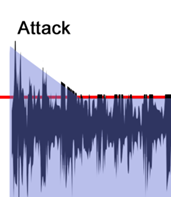
Next we will see a compressor with a slower attack: We see that the compression takes longer to arrive, leaving room for the first signals to cross the threshold. This gives a smoother and more dynamic sound. For example, it would be useful for compressing vocals, if we want them to sound natural. Once compressed too much it sounds unnatural and abrupt.
Release
Become an expert in compression with the recommended book “ Compression in Music Production” (click on the image to go to the link):

The Release of a Compressor is the time it takes for a compressor to return to the normal state of the signal once it does not exceed the threshold.
The longer the Release time, the longer the compressor holds the signal and the smoother the sound. A faster release means that the compressor is released quickly, and the signal retains more of the original dynamics.
