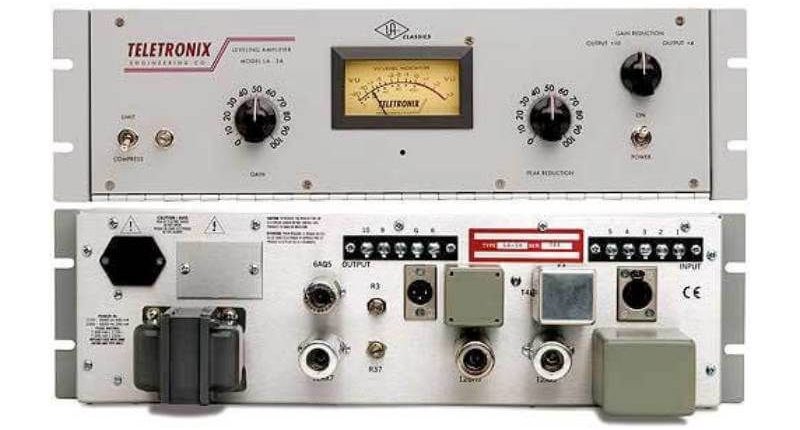
Software Advantages (Plugins)
- Cost:
- Advantage: Software plugins are usually much less expensive than their hardware counterparts. This makes them accessible to a wider range of users, including beginners and studios with limited budgets.
- Portability:
- Advantage: Plugins can be used anywhere as long as you have access to your computer and production software (DAW). There is no need to carry heavy equipment.
- Flexibility:
- Advantage: Plugins offer great flexibility in terms of automation and precise parameter control. In addition, multiple instances of the same plugin can be loaded in one session, something impossible with hardware.
- Upgrades and Continuous Improvement:
- Advantage: Software developers can release updates to improve performance, add new features and fix bugs. This ensures that plugins keep up with the latest technological innovations.
- Integration with DAWs:
- Benefit: Plugins are designed to integrate seamlessly with digital audio workstations (DAWs), allowing for workflow fluidity and easy parameter automation.
- Retrieval and Configuration:
- Advantage: Plugin configurations can be easily saved and recalled, which is ideal for projects that require consistency over time.
Software Disadvantages (Plugins).
- Sound and Character:
- Disadvantage: Although many plugins emulate the sound of vintage hardware, some purists argue that plugins cannot fully replicate the warmth and distinctive character of analog hardware.
- Resource Consumption:
- Disadvantage: Plugins can consume a significant amount of computer CPU and memory resources, especially when multiple instances are used simultaneously.
Hardware Advantages.
- Sound Quality:
- Advantage: Many audio engineers prefer the sound of analog hardware for its warmth, character, and the harmonic distortion it adds to the audio. The interaction of the physical components often results in a sound that some consider more “musical” and “organic.”
- Physical Manipulation:
- Advantage: The ability to adjust physical controls can be more intuitive and satisfying to many engineers. Tactile interaction with knobs and faders can facilitate finer and faster adjustments.
- Reliability:
- Advantage: Hardware equipment, especially high quality hardware, can be extremely reliable and durable. They are not dependent on software upgrades or operating system compatibility.
- System Independence:
- Advantage: Hardware is not dependent on the operating system or computer processing power, which can be critical in live recording environments or studios with heavy digital workloads.
Become an expert in compression with the recommended book “ Compression in Music Production” (click on the image to go to the link):

Hardware Disadvantages.
- Cost:
- Disadvantage: Quality hardware can be extremely expensive, making it inaccessible to many musicians and small recording studios.
- Portability:
- Disadvantage: Hardware is physical and therefore less portable. Transporting bulky equipment can be impractical and expensive.
- Flexibility and Availability:
- Disadvantage: Each hardware unit can be used on only one track at a time. If the same effect is needed on multiple tracks, multiple units or a reprinting process is required, which can be tedious.
- Maintenance:
- Disadvantage: Hardware requires regular maintenance, such as cleaning, calibration and, in some cases, component replacement, which can be costly and time consuming.
The choice between software (plugins) and hardware depends on several factors, including budget, working environment, personal preferences and specific project needs. Plug-ins offer a flexible, cost-effective and highly integrable solution with DAWs, making them ideal for modern studios looking for efficiency and portability. On the other hand, the hardware provides a sound quality and tactile experience that many consider unsurpassed, which can be crucial in professional environments where sonic character and reliability are paramount.
For many engineers and producers, a combination of both worlds offers the best of each, using hardware for sound-critical tasks and plug-ins for production flexibility and efficiency.