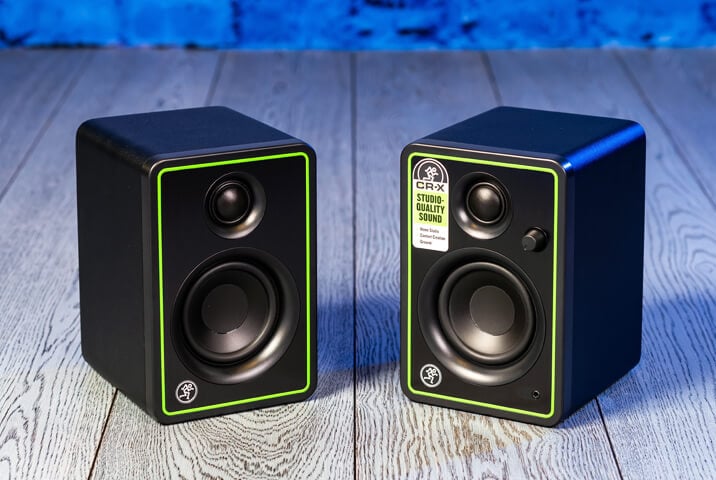
Near-field monitoring is a common practice in recording studios, especially in small and medium-sized spaces. This type of monitoring involves placing the monitors at a relatively short distance from the listener, usually between one and two meters. The proximity of the monitors minimizes the influence of room acoustics, allowing for more accurate and direct listening to the audio material.
In the near-field configuration, the monitors are placed on stands or on the workbench at the height of the listener’s ears. Forming an equilateral triangle with the listening position, the monitors ensure that the sound arrives in a balanced manner from both loudspeakers. This positioning reduces early reflections from the walls, ceiling and floor, providing a clearer stereo image and a more accurate representation of the audio.
The near-field monitors are designed to provide a flat frequency response, which means they do not exaggerate or attenuate any part of the sound spectrum. This allows sound engineers to make informed decisions during mixing and mastering. Popular models of near-field monitors include the Yamaha HS5, KRK Rokit and Genelec 8010, known for their accuracy and clarity.
One of the main advantages of near-field monitoring is that it allows you to work in acoustically imperfect environments. Since the proximity of the monitors reduces the influence of room characteristics, it is possible to obtain a good sound reference even in spaces that have not been optimally acoustically treated. This makes near-field monitoring an ideal choice for home studios and project studios.
Become an expert in monitoring with the recommended book “Acoustings and monitoring in Music Production” (click on the image to go to the link):

Far Field Monitoring
Far-field monitoring, also known as main monitoring, is used in large professional studios. In this configuration, monitors are placed at a greater distance from the listener, usually more than four meters. Far-field monitors are larger and more powerful, capable of producing very high sound pressure levels and an extended frequency response that includes deep low frequencies.
These monitors are typically recessed into the front walls of the control room to minimize unwanted reflections and resonances. The recessed placement helps avoid phase interference and provides a more uniform frequency response. Brands such as Genelec and ATC are known for their high-quality far-field monitors, which offer accurate and detailed sound reproduction.
Far-field monitoring allows sound engineers to evaluate how the mix will sound in large-scale playback environments such as theaters and stadiums. This type of monitoring is essential for music and film production, where it is crucial to hear all the details of the recording at high levels without distortion. The additional distance allows for a more natural integration of room reflections, providing a more immersive and realistic listening experience.
However, far-field monitoring requires careful acoustic treatment of the room. Large control rooms must be designed to handle reflections and resonances effectively, using absorbent materials and strategically placed diffusers. Reverberation time must be controlled to ensure optimum clarity and definition.
The use of far-field monitors also requires accurate calibration. Sound engineers use acoustic measurement tools to adjust frequency response and volume levels, ensuring that the monitors provide a neutral sound reference. This includes measuring frequency response at multiple points in the room and applying equalization adjustments as needed.